
Technology and AI: Transforming Health Professions Education
- Harvard Macy Institute
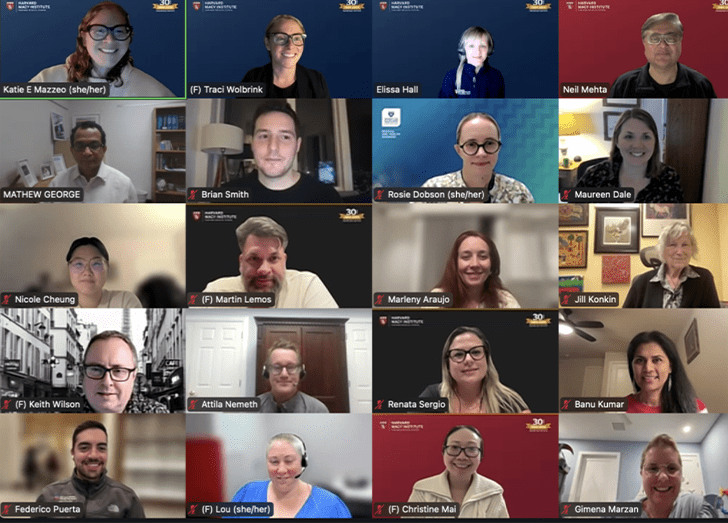
Transform health professions educational environments by building skills in the integration of emerging technologies and generative AI to drive learning and innovation.
- Live Online
This program is taught online in real time.
Continuing Education
8 Weeks, 2 Required Sessions/Week
The program will be held virtually Tuesday and Thursday nights from 7-9 pm ET, over the course of eight weeks.
On This Page
Overview
As digital transformation accelerates, health professions educators are increasingly called upon to adapt to a rapidly changing landscape. This innovative eight-week, live online course equips educators to thoughtfully integrate emerging technologies, including generative AI, into their educational practice, leadership, and program development. Immersive and hands-on, the course provides practical tools and strategies to enhance teaching, assessment, active learning, curricular design, and collaboration across diverse educational settings.
Participants will also examine responsible AI use, including issues related to privacy, bias, academic integrity, accessibility, transparency, and appropriate human oversight.
Learning Objectives
- Integrate technology into diverse health profession learning environments, aligning learning goals, teaching strategies, and technology using evidence-based approaches.
- Apply new tools and frameworks to enhance active learning, assessment, and curricular co-creation.
- Foster experiential, collaborative, innovative technology-enhanced learning environments.
- Critically evaluate emerging technologies, including generative AI and apply them responsibly to advance educational practice.

About the Program
Grounded in learning science and real-world application, the curriculum supports participants in reimagining their teaching and leadership in technology-rich environments. Educators learn to design impactful, evidence-based learning experiences for all levels of health professions learners by incorporating generative AI, innovative digital tools, and universal design principles that promote accessibility and engagement. Through extensive hands-on practice, including leveraging AI for visualizations, and microteaching, participants strengthen skills in curriculum design, feedback, assessment, project management, and digital scholarship. The program culminates in a personalized technology toolbox that supports ongoing growth as a transformative educator and leader.
Program Format
Delivered over eight immersive weeks on Tuesday and Thursday evenings (EST), the course features hands-on learning through large and small group sessions, personalized consultation, and practical experience in designing and implementing new educational approaches.
Who Should Apply
This program is ideal for health professions educators and leaders at all levels who seek to enhance their educational practice and impact through technology and AI.
Program Faculty

Elissa Hall
EdD, MA
- Scientific Director, Advanced Digital Education, Mayo Clinic
- Program Director, Mayo Clinic Harper Family Foundation Artificial Intelligence Education in Medicine Program
- Assistant Professor, Mayo Clinic College of Medicine and Science
- Chair, AAMC Group on Educational Affairs

Neil Mehta
MBBS, MS
- Professor of Medicine
- Associate Dean for Curricular Affairs, Cleveland Clinic Lerner College of Medicine of Case Western Reserve University

Traci Wolbrink
MD, MPH
- Co-Director, OPENPediatrics
- Director of Education, Department of Anesthesiology, Critical Care, and Pain Medicine, Boston Children's Hospital
- Associate Professor in Anesthesia, Harvard Medical School
Program Fee
Program fees do not include airfare, accommodation, meals, or educational materials. Review Cancellation Policy
| Program Fee | |
|---|---|
| Early Application Deadline: November 18, 2026 | $2,700 |
| Final Application Deadline: January 13, 2027 | $2,900 |
Medical Education Learning Opportunities

"The course directors and the expert team of faculty demonstrated AI’s potential through their own insights and experiences, showing me how I could remain the chef in my kitchen, with AI as my sous-chef."
Interview with Technology and AI: Transforming Health Professions Education Alumna Deeksha Sikri
Learner Stories and Insights


One Clinician’s Journey Reimagining Teaching Using Technology
"If you want to transform your teaching—and yourself as an educator—this course shows you how."

Interview with Technology and AI: Transforming Health Professions Education Alumnus Jeffrey Huang
"It was awesome seeing all the innovative ways that the course faculty and fellow scholars were using a wide variety of different tools, many of which I had never even heard of."
Request Information
Interested in learning more about this program? Sign up for details.
Accreditation

The Harvard Medical School designates this live activity for a maximum of 30.00 AMA PRA Category 1 Credit(s)™. Physicians should claim only the credit commensurate with the extent of their participation in the activity.
For the purpose of recertification, the American Academy of Nurse Practitioners Certification Board and American Nurses Credentialing Center accept AMA PRA Category 1 Credit™ issued by organizations accredited by the ACCME (Accreditation Council for Continuing Medical Education). We would also suggest that learners check with their state licensing board to ensure they accept reciprocity with AMA PRA Category 1 Credit™ for re-licensure.
The National Commission on Certification of Physician Assistants (NCCPA) states that AMA PRA Category 1 Credits™ are acceptable for continuing medical education requirements for recertification. We would also suggest that learners check with their state licensing board to ensure they accept reciprocity with AMA PRA Category 1 Credit™ for re-licensure.
The Royal College of Physicians and Surgeons of Canada recognizes conferences and workshops held outside of Canada that are developed by a university, academy, hospital, specialty society or college as accredited group learning activities.
The American Medical Association (AMA) has an agreement of mutual recognition of continuing medical education (CME) credit with the European Union of Medical Specialists (UEMS). Additional information regarding this agreement may be found on the Union of European Medical Specialists website.