
The Power of the Cognitive Flow State
MedEdPearls March 2026: Using the Flow State Model to Decode Learner Behavior

Many learners struggle academically and personally, causing them to feel as if they are in a “rut.” Yet, many learners have experienced elevated mental states, including being “in the zone” while writing a paper or obtaining a ‘runners high’ during a race. How can medical and health professions educators help learners flourish and thrive in the face of challenges to help them find their productive flow?
The “flow state” is a maximum level of cognitive performance involving a total absorption and immersion into a challenging task. During the flow state, the learner experiences intense focus and creative engagement with a reduced level of consciousness, rendering the learner with such ease that nothing else seems to matter, including time and self. A flow state experience provides learners with enhanced learner affect, including positivity, resilience, confidence, acceptance of mistakes, and improved coping with setbacks.
The flow state occurs when a particular learning task induces a strong interaction between a learner’s ability to execute the task and a high willingness to engage in that task (Figure 1).
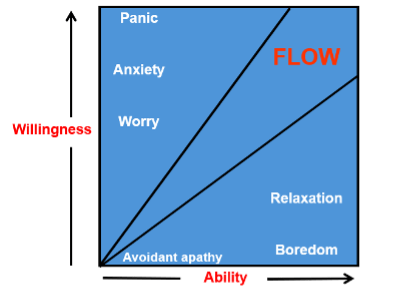
Entering the cognitive flow state can be offered as a study strategy by teaching learners how to enter it. Two factors make a flow state more likely to occur, including certain task elements and characteristics of the learning environment. Favorable task elements needed for achieving the flow state include selecting a specific and feasible task, matching high learner ability for a task with a high willingness to engage in that task, boosting positive emotion for the task to increase intrinsic motivation, developing clear goals at every step to guide task completion, and having an autotelic experience that makes the task enjoyable regardless of its outcome. Environmental factors needed for achieving the flow state include designing a fertile environment that facilitates focused concentration free of distraction, providing self-feedback that is clear and immediate, experiencing a loss of self- and time-consciousness, and maximizing autonomy to navigate obstacles and boost self-confidence.
The flow state model can also provide educator insight into learner behaviors. For example, if a rotating medical student desiring surgery residency avoids writing patient notes during a psychiatry rotation, the flow state model suggests that this avoidance behavior stems from both a lack of willingness and ability for writing psychiatric patient notes (Figure 1). Alternatively, if a first semester medical student presents with high anxiety while preparing for their first gross anatomy exam, the flow state model suggests that despite a high willingness to engage in test preparation, their anxiety stems from a self-perceived lack of knowledge and skills needed to succeed (Figure 1). Conversely, learner boredom stems from an incongruent match between high ability and low willingness for the task at hand (Figure 1).
Experiencing the flow state results in the learner’s growth of expertise. The cognitive flow state model can serve as part of a medical and health professions educators toolbox for helping learners develop study strategies. It can also be used for providing learner-behavior diagnostics.
#MedEdPearls are developed monthly by the Health Professions Educator Developers on Educational Affairs. Previously, #MedEdPearls explored similar topics, including elevating emotional intelligence, using rapid prototyping, and professional identity formation.
About the MedEd Pearls Author
The MedEdPearls are a collaborative, peer-reviewed, monthly brief intended to provide practical tips and strategies for medical and health professions educators to enhance teaching and learning.

- Assistant Dean of Medical Education; Institutional Director of Professional Development; Program Director, PhD and MS programs in Medical Education, Lake Erie College of Osteopathic Medicine
- Jean Bailey, PhD – Virginia Commonwealth University School of Medicine
- Carrie Bowler, EdD, MS, MLSCM (ASCP) – Mayo Clinic School of Continuous Professional Development
- Kristina Dzara, PhD, MMSc (Educators ’16; Assessment ’16; HCE 2.0 ’17) – Saint Louis University School of Medicine
- Shanu Gupta, MD, SFHM – University of South Florida Morsani College of Medicine and Tampa General Hospital
- Jennifer Hillyer, PhD – Northeast Ohio Medical University
- Aimee M. Hollander, PhD - Medical University of South Carolina
- Larry Hurtubise, PhD, MA (HCE 2.0 '16) – The Ohio State University
- Anna Lama, EdD, MA – West Virginia University School of Medicine
- Machelle Linsenmeyer, EdD, NAOME (Assessment ’07) – West Virginia School of Osteopathic Medicine
- Skye McKennon, PharmD, BCPS, ACSM-GEI – Washington State University Elson S. Floyd College of Medicine
- Rachel Moquin, EdD, MA – Washington University School of Medicine
- Stacey Pylman, PhD – Michigan State University College of Human Medicine
- Leah Sheridan, PhD – Northeast Ohio Medical University
- Mark Terrell, EdD – Lake Erie College of Osteopathic Medicine
- Stacey Wahl, PhD – Virginia Commonwealth University School of Medicine