
Why Professional Identity Formation Matters Now for Medical Educators
MedEdPearls January 2026: Intentional Identity, Community, and Growth in Medical Education
At the AAMC Annual Meeting–Learn Serve Lead 2025, Kelly Kovaric, MD, Anna Lama, Ed.D., Stephanie Corliss, PhD., Holly West DHEd, PA-C., and Deborah Simpson, Ph.D., challenged the audience to consider an important question: When and how should you start thinking about your professional identity formation as a medical educator?
Professional Identity Formation (PIF) is the ongoing, deliberate process through which individuals integrate the values, norms, and behaviors of their profession into who they are. PIF develops not automatically but through relationships, reflection, lived experiences, learning new skills and values, and socialization within the professional community–all of which shape a learner’s provisional self. This evolving identity shapes how we teach, give feedback, experience belonging, and see ourselves in changing roles. While PIF is often emphasized in medical student education as learners prepare for their future roles, it is equally relevant for practicing medical educators or those emerging as clinical educators. How do you think about your identity as a medical educator—and have you started this reflection yet?
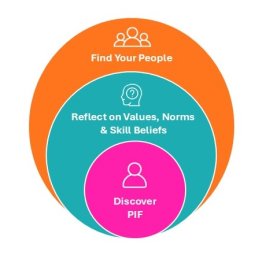
Strategies to Help Think about Your PIF as a Medical Educator
1. Understanding What PIF is and its Importance
Who am I becoming as an educator? What do I want to be known for? PIF is not a competency checklist, a professionalism requirement, or something reserved only for learners. It is about meaning, belonging, and becoming–the transformation from simply doing the work of a physician or educator to being one in mind, heart, and practice. PIF is dynamic and multilayered. Most medical and health professions educators hold several intertwined identities, such as but not limited to: clinician, educator, researcher, evaluator, mentor, leader, and more. These layers of identity recombine and shift across one’s career and across different professional contexts, shaping PIF at both the individual and at the collective levels.
2. Individual Reflection: Values, Norms, Skill Beliefs
What principles guide your decisions in the classroom, clinic, or mentoring relationships? Reflection invites you to examine the assumptions you hold about good teaching and good doctoring and how these assumptions were shaped by your role models, early training, or institutional culture. Tools like the Clinician Educator Milestones can help you assess your current competency domains and identify areas for growth, but the heart of this step is honest personal reflection. Try starting with simple self-reflection questions:
- When did I most feel like a good educator?
- What values guide my approach to teaching or mentoring?
- What norms or hidden messages from my training still influence me today?
- What skills do I feel confident in, and where do I want to grow?
3. Find Your People: Communities of Practice and Connection
Who are the colleagues that can help you grow into the educator you want to be? Identity is co-constructed between individuals and their workplace contexts. We become who we are through membership in communities—teams, teaching groups, specialty societies, faculty development groups, and scholarly networks. Many educators experience feeling undervalued or even disconnected from their educator identity. If you have felt this, you are not alone, and there are ways to reconnect.
Start locally:
- Teaching partners
- Peer coaching groups
- Mentors or colleagues with whom you naturally debrief
- Faculty development sessions or medical education journal clubs where you can make connections with colleagues
Expand Nationally and beyond:
- AAMC Affinity Groups, if you work primarily within a medical school, academic health center, or institution affiliated with the AAMC, and your role involves medical or health professions education, curriculum, student affairs, or assessment.
- American Educational Research Association (AERA), if you work in an academic setting where education research is part of your role–including medical schools, colleges of education, research institutions, or interdisciplinary research centers.
- Alliance of Independent Academic Medicine Centers (AIAMC), if you work primarily in a setting not operated by a medical school.
- International Association for Health Professions Education (AMEE), if you work in an academic setting where education research is part of your role–including medical schools, colleges of education, research institutions, or interdisciplinary research centers.
- International Association of Medical Science Educators (IAMSE), if you work primarily in a basic science, preclinical, or foundational science teaching setting, or if you bridge clinical and basic science education within a health professions curriculum.
- Society for Teachers of Family Medicine (STFM) if you work primarily as a health care professional in the education of family medicine physicians.
- The Generalists in Medical Education (TGME), if you work in any health professions education setting–medical school, residency program, or related health sciences program–and want a practical, collaborative community focused on day-to-day teaching and curriculum work.
The benefits of finding your people can include shared language and norms, validation and belonging, feedback that supports growth, and modeling of educator identity. Have you started thinking about your PIF yet? The conversation about PIF is growing—and you are part of it. We invite you to start small; choose one self-reflection question or one new community connection this month. Your educator identity is already evolving. The opportunity now is to shape it intentionally.
Special thanks to Kelly Kovaric, MD, Stephanie Corliss, PhD, Holly West DHEd, PA-C, and Deborah Simpson, PhD for their contributions to this post.
About the MedEd Pearls Author
The MedEdPearls are a collaborative, peer-reviewed, monthly brief intended to provide practical tips and strategies for medical and health professions educators to enhance teaching and learning.

Anna Lama
EdD, MA
- Associate Professor, Medical Education; Director of Assessment for Undergraduate and Graduate Medical Education, West Virginia University School of Medicine
- Jean Bailey, PhD – Virginia Commonwealth University School of Medicine
- Carrie Bowler, EdD, MS, MLSCM (ASCP) – Mayo Clinic School of Continuous Professional Development
- Kristina Dzara, PhD, MMSc (Educators ’16; Assessment ’16; HCE 2.0 ’17) – Saint Louis University School of Medicine
- Shanu Gupta, MD, SFHM – University of South Florida Morsani College of Medicine and Tampa General Hospital
- Jennifer Hillyer, PhD – Northeast Ohio Medical University
- Aimee M. Hollander, PhD - Medical University of South Carolina
- Larry Hurtubise, PhD, MA (HCE 2.0 '16) – The Ohio State University
- Anna Lama, EdD, MA – West Virginia University School of Medicine
- Machelle Linsenmeyer, EdD, NAOME (Assessment ’07) – West Virginia School of Osteopathic Medicine
- Skye McKennon, PharmD, BCPS, ACSM-GEI – Washington State University Elson S. Floyd College of Medicine
- Rachel Moquin, EdD, MA – Washington University School of Medicine
- Stacey Pylman, PhD – Michigan State University College of Human Medicine
- Leah Sheridan, PhD – Northeast Ohio Medical University
- Mark Terrell, EdD – Lake Erie College of Osteopathic Medicine
- Stacey Wahl, PhD – Virginia Commonwealth University School of Medicine