
Sequencing Strategies
- Continuing Education
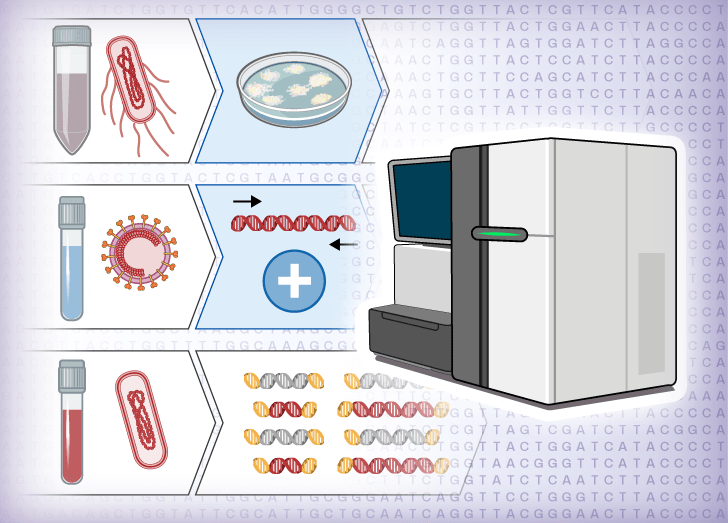
See how sequencing strategies shape how pathogen genomic data can be used in public health.
- Online; Self-Paced
This course is offered on demand and participants progress through the materials at their own pace.
Free
Continuing Education
This course does not offer CME Credits.
2 Hours
On This Page
Overview
Sequencing Strategies guides learners through the key decisions that shape the generation of genomic sequencing data for public health applications. Building on the foundations of pathogen genomics, this course unpacks the sequencing workflow from sample to data, introduces a practical toolbox of sequencing library construction approaches—including untargeted, amplicon-based, and target capture methods—and explains how starting material (cultured isolates versus direct specimens) influences what is technically feasible and scientifically appropriate.
This course examines how different genomic sequencing strategies support core public health use cases such as pathogen characterization, genomic surveillance, and outbreak investigation, and how choices around cost, turnaround time, throughput, and instrumentation affect what questions can realistically be answered. By the end of the course, learners will understand how sequencing strategies align with specific pathogens, specimens, and program goals, and appreciate the trade-offs that underpin sequencing strategy choices in practice.
Key concepts are presented in brief, accessible video segments, with assessments throughout to help you check your understanding and apply your learning. With a focus on applying conceptual understanding and core principles to public health processes, this course equips learners to see how choices about sequencing strategy shape the use of pathogen genomic data in public health settings.
Learning Objectives
- Describe common approaches to constructing a sequencing library and understand their general differences.
- Explain how pathogen biology, sample characteristics, use cases, and other considerations can constrain or enable different sequencing strategies.
- Evaluate and justify the selection of an appropriate sequencing strategy for common public health applications.
Who Should Enroll?
public health applications. Completion of Foundations I and Foundations II is recommended before taking this course and subsequent courses in this program.
Course Topics
Course Introduction
- Stumped by Starbacter: A Sequencing Strategy Dilemma in Robinwood
Sequencing Strategy Matters
- Understanding the Toolbox of Sequencing Strategies
- How Specimen Type Informs Sequencing Strategy
- How Use Case Informs Sequencing Strategy
- Practical Considerations That Can Impact Sequencing Strategy
- Sequencing Strategies in Practice: Key Takeaways

Acknowledgments
These courses were developed under the U.S. Pathogen Genomics Centers of Excellence (PGCoE), and supported by the Office of Advanced Molecular Detection, U.S. Centers for Disease Control and Prevention (CDC) through Cooperative Agreement Number CK22-2204. Contents are solely the responsibility of the authors and do not necessarily represent the official views of the Centers for Disease Control and Prevention.
Course Directors

Daniel Park
PhD
- Senior Group Leader, Viral Computational Genomics
- Institute Scientist, Broad Institute of MIT and Harvard

Sara Vetter
PhD, D(ABMM)
- Director, Public Health Laboratory, Minnesota Department of Health
This course is non-accredited.
Note: Physicians may be able to self-claim AMA PRA Category 2 Credit™ for participation in activities not certified for AMA PRA Category 1 Credit™. AMA Category 2 Credit™ is self-designated by physicians for learning that meets the AMA definition of CME and ethical standards, and is relevant and worthwhile to their practice. Examples of activities that may qualify include teaching, peer discussions, reading medical literature, research, writing, and quality improvement work. Physicians must decide for themselves whether this course qualifies for AMA PRA Category 2 Credit™. Additional information from the AMA regarding AMA PRA Category 2 Credit™ can be found here: What to know about the other kind of CME credit.