Expanding Surgical Leadership Through Collaboration and Innovation
"I loved being exposed to such a wide breadth of perspectives, while being comforted by all the things we had in common and motivated by everybody’s drive to expand their knowledge and maximize their ability to contribute."
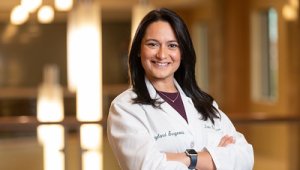
Irina Bernescu, MD, is a board-certified surgeon in both general surgery and colorectal surgery. After completing her surgical training in 2015 and spending two years in private practice, she joined Ascension Saint Agnes in Baltimore, Maryland, where she helped introduce robotic colorectal surgery. Approaching her tenth year in clinical practice, Bernescu began seeking new ways to expand her organizational skills and prepare for greater leadership opportunities.
Interested in how Irina Bernescu's journey has progressed? Read her updated interview.
Harvard Medical School’s Surgical Leadership Program offered the perfect next step, combining leadership development, business strategy, and innovation in health care in a way that was immediately relevant to her daily work, while shaping her long-term professional goals.
Learning Through Global Perspectives
For Bernescu, the program exceeded her expectations. “It was rewarding and impactful in so many ways—more than I could have anticipated,” she notes. “The material itself was valuable, and the class exercises and projects were thought-provoking and stimulating. What I enjoyed most, however, were the direct interactions with such inspiring faculty and the relationships formed with classmates from a variety of countries, surgical specialties, and backgrounds.”
Because her Surgical Leadership Program cohort included participants from 36 countries, she especially valued the diversity of viewpoints shared within the group. “I loved being exposed to such a wide breadth of perspectives, while being comforted by all the things we had in common and motivated by everybody’s drive to expand their knowledge and maximize their ability to contribute.”
Turning Ideas into Action
During the program, each participant develops and refines a capstone project, an opportunity to apply newly gained leadership and strategic skills toward solving a real-world challenge in health care. Bernescu’s capstone project focused on addressing the inefficiencies in clinical practice and reducing the barriers to patient care.
“My capstone project described an innovative solution to some of the inefficiencies encountered in clinical practice and some existing and anticipated barriers to patient care,” she explains. “I enjoyed the opportunity to describe the idea and formulate a plan to execute it, and I am still considering whether to pursue the development of this solution further.”
Advice for Future Participants
Reflecting on her experience, Bernescu emphasizes the Surgical Leadership Program’s enduring value. “While you will acquire concrete skills and knowledge as expected, the value of the experience goes far beyond the actual curriculum. The perspectives shared and gained will become an invaluable foundation on which you will continue to build.”
Alumni Ambassador Insights
Updated as of March 2026
- What motivated you to enroll in the Surgical Leadership Program, and what were you hoping to gain from the experience?
As I was approaching my 10th year in colorectal surgery practice and feeling confident clinically, I wanted to position myself strategically for the next stage of my career. I wanted to prepare for leadership opportunities that would allow me to implement improvements in patient care on a larger scale. I could see value in a variety of different programs that I considered (such as MBA, MHA, MPH), but in exploring the Surgical Leadership Program curriculum, I felt that it would provide a wide foundation of practical skills that overlapped with all these different programs. Even more, I liked that I would also learn concepts specific to leadership and innovation, that are just as relevant to my career goals.
- How has the program influenced your professional growth or opened new opportunities in your career?
I have long felt, based on experience in a variety of healthcare institutions, that successful leaders would have the role of bridging the gap between clinician and administration/business teams, by being fluent in both languages and understanding the needs and priorities of both. I feel that the program provided a great base of knowledge on financial concepts and terms that facilitate productive conversations and gave me the ability to engage in those dialogues with more knowledge and confidence.
Even more than concrete skills, the leadership and human relations modules shifted my perspective on what true leadership entails and what the important elements of team building are. I’ve continued to build on this foundation since completing the program and have been excited to apply it towards new initiatives at my institution.
- What advice would you share with professionals considering the Surgical Leadership Program?
I would share that this program changed me in ways that are far beyond, and I would say even more meaningful than, the concrete skills I acquired through the wide breadth of modules and exercises. The ability to engage directly with brilliant faculty from different Harvard University schools and programs and to collaborate and share ideas with surgical professionals from a wide variety of backgrounds provided value that would be impossible to replicate in any other setting and that I didn’t really appreciate until I was experiencing it first hand. I would also add that the workload is thoughtfully structured and thus manageable for a busy surgical specialist, while also including the opportunity for focused in person learning and networking. I believe this course will be a great asset to your leadership journey in ways that will continue to become apparent as you progress towards your goals.