
AI-Enabled Solutions for Health Care: Connected Learning Path
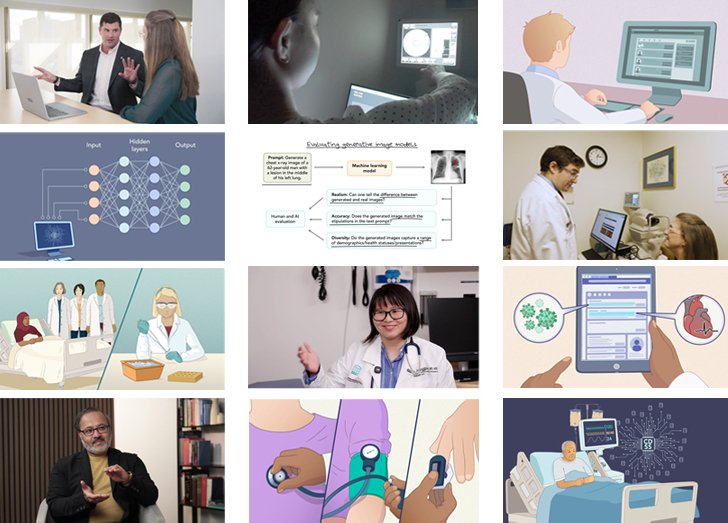
Learn how AI works and how it performs in clinical care and life sciences, then decide where it belongs in your setting.
- Online; Instructor-Paced
You will follow a shared weekly schedule with your cohort while also completing self-paced work and your capstone project.
$1,875 Save with early registration
Join the first cohort and take advantage of an introductory offer with early registration.
Fee increases to $2,495 after
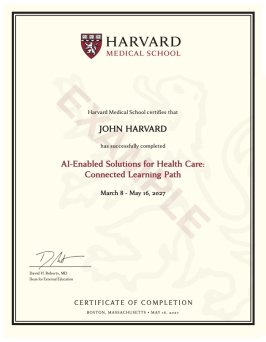
Certificate
Earn a Certificate of Completion upon successfully completing all coursework and the capstone project.
10 weeks, 2-3 hours/week
3 Live Online Sessions: March 11, April 8, and May 11, 2027 from 12-1 PM ET;
Complemented by self-paced work and a capstone project.
On This Page
Overview
AI-Enabled Solutions for Health Care is a 10-week, online Connected Learning Path from Harvard Medical School for health care professionals who want to evaluate AI opportunities and understand how they apply in clinical, research, and organizational settings. The program brings together lessons from three HMS courses (AI in Medicine: Foundations and Applications, AI in Medicine: Evaluating Real-World Applications in Health Care and Life Sciences, and Digital Innovations in Health Care) with live sessions, peer feedback, and a capstone project.
Led by Harvard Medical School faculty, you will complete seven lessons with a cohort of peers from a range of health care fields. During the program, you will hear patient stories, learn from faculty conversations, and virtually visit labs and clinical settings, so each lesson connects to clinical and research practice. Along the way, you will build a capstone project, your AI Opportunity Brief, around a real challenge at your work.
Designed for professionals who bring clinical, scientific, and operational expertise to their work, this Connected Learning Path provides the vocabulary and evaluation framework to apply that expertise to AI and independently assess tools, vendor claims, and proposed use cases.
Learning Objectives
- Explain how real-world data becomes evidence, and analyze the data landscape for a proposed AI application.
- Describe how machine learning and generative AI models are built, and how their performance is evaluated before clinical use.
- Explain how health systems evaluate AI tools for clinical use, and how EHRs, decision support, and interoperability shape where AI fits.
- Evaluate AI output in diagnosis and documentation for fabrications and other errors, and match human oversight to the risk of harm.
- Explain how AI is used in biomedical research, from drug discovery to trial matching, and the limits of its outputs.
- Analyze patient-facing AI tools for ethical, equity, and privacy risks, including who they may underserve.
- Determine whether a proposed AI tool would likely be regulated as a medical device, and what to monitor after deployment.
- Build an AI Opportunity Brief: a scoped case for or against AI for a problem you face at work.
About the Program
Who Should Enroll
This Connected Learning Path is built for professionals who want to evaluate AI tools and decide whether and where they belong in their work. Learners from range of roles are recommended, including:
- Clinicians
- Health care administrators and leaders
- Medical researchers
- Health IT and informatics professionals
- Medical affairs and medical science liaisons
- Life science professionals involved in clinical trial design and execution
- Regulatory, compliance, and drug safety professionals
- Tech industry professionals
- Health care consultants
Program Format
The Connected Learning path runs for 10 weeks, from March 8 – May 16, and takes about 2-3 hours a week. Each week will include independent study and project work, with structured peer feedback at set points along the way. During the program you will complete seven self-paced, online lessons and have three live online faculty sessions, along with peer feedback, and a capstone project.
Live Online Sessions
- Kickoff: Thursday, March 11, 2027
- Design and Risk Clinic: Thursday, April 8, 2027, with a case study from a practitioner who took an idea for an AI-enabled solution from problem definition to cross-departmental buy-in
- Showcase: Tuesday, May 11, 2027
Each session is one hour, 12-1 PM ET, and attendance is strongly encouraged but not required.
Key Program Components
Community and Support
- A cohort-wide space for introductions, announcements, and questions
- A small group for project work and close peer feedback
- An AI learning partner that asks what you already think before it offers an explanation and helps you work through your brief without writing it for you
Practical Application: Your Capstone Project
The AI Opportunity Brief is a capstone project that makes the case for, or against, an AI solution to a problem in your work setting. The brief is how you turn what you learn into something your department can act on. You will build it in four parts across the path, with peer provide feedback on your work as you go. Volunteers will present their 8-12 slide pitch deck at the closing showcase.
It helps to arrive thinking about a problem you face at work, though it isn’t required. If you’re not sure which problem fits best, or you’re finding it hard to name a specific need, we’ll work on that together in the first week.
- Part 1: problem statement, AI fit assessment, and data landscape
- Part 2: workflow plan, stakeholder map, and early risk summary
- Part 3: equity analysis
- Part 4: likely regulatory status, and what to monitor once it’s in use
AI Learning Partner
An AI learning partner provides a place to think through your problem. It is grounded in this path's materials, asks what you already think before it offers an explanation, and helps you work through your AI Opportunity Brief without writing it for you
Ready to Enroll?
The cohort begins the week of March 8, with a kickoff on Thursday, March 11.
What You Earn
Learners who complete the program requirements, including your AI Opportunity Brief capstone project, will earn a Certificate of Completion from Harvard Medical School. After completing this Connected Learning Path you will become an integral part of a worldwide network of past participants of Harvard Medical School’s professional, corporate, and continuing education programs and courses.
Faculty

Jacqueline You
MD, SM
- Digital Principal Clinical Informaticist for Brigham and Women's Hospital, Digital, Mass General Brigham
- Associate Physician, Primary Care Associates of Longwood, Division of General Internal Medicine and Primary Care, Department of Medicine, Brigham and Women's Hospital
- Instructor, Harvard Medical School
Alexander J. Blood, MD, MSc, FACC
David Blumenthal, MD, MPP
John Halamka, MD, MS
Daniel Liebman, MD, MBA
Mallika Marshall, MD
Rebecca Mishuris, MD, MS, MPH, FAMIA
Shawn Murphy, MD, PhD
Michael J. Parker, MD
Eric Perakslis, PhD
Gaurav Singal, MD
Vishal Vaidya, PhD
What is a Connected Learning Path?
Connected Learning Paths are cohort-based, online experiences from Harvard Medical School for health care professionals, built around clinical immersion. Each path combines self-paced learning with live discussions led by Harvard Medical School experts. You will learn with a group of peers from across the health care industry, connect new ideas to real-world clinical and research settings, and apply what you learn to a challenge at your workplace.
By the end of the path, you’ll have a practical work product, new perspectives to inform your decisions, and a Certificate of Completion from Harvard Medical School. Designed for clinicians, health care leaders, researchers, and industry professionals, Connected Learning Paths help you turn learning into action.

Request Information
Interested in learning more about this program? Sign up for details.