Narrative Medicine to Expand the Reach of Health Professions Education
In this Harvard Macy Institute blog post, alternative models of health professions education are discussed.

In the quarter-century since narrative medicine was defined, humanities programs have become commonplace in health professions education. A scoping review commissioned by the Association of American Medical Colleges (AAMC) and published in Academic Medicine in 2021 found that most schools still offer humanities content only as elective or extracurricular programming, taught by medical or health faculty in classroom or clinical settings. Fewer than 10% of programs explicitly discussed interprofessional education or engaged the local community. The report identified only four instances, less than 1%, of patients serving as teachers.
Although narrative medicine holds the promise of improved connection between clinician and patient, we should expand our educational frameworks to include non-traditional teachers in less typical spaces. There are important structural considerations in developing and integrating new coursework into a health professions program, including curriculum mapping, achievement of competencies and milestones, and validity in assessment, grading, and credit. However, over-adherence to an academically familiar format of lectures and seminars may inadvertently prevent deeper connections between academia and the community it purports to serve. The lack of inclusion of patients as teachers discounts their lived experience as expertise, despite evidence that meaningful involvement of patients in co-constructing educational resources can reduce stigma, improve communication, and enhance knowledge.
What might an alternative model of health humanities in professional education look like? At Duke University School of Medicine, the Armstrong Humanities Scholars Program blends traditional classroom and clinical sessions with public engagement and digital humanities, with the aim of developing health care professionals with a commitment to structural change in health care, regardless of specialty or practice setting. The introductory course is an interdisciplinary and interprofessional elective, combining faculty-facilitated seminar discussions on topics ranging from disability studies to climate health with experiential patient and community activities such as social history walks, narrative interviews inspired by the My Life My Story project, service learning at the county health department, and supporting arts and culture activities sponsored by local patient advocacy groups. The course also includes an emphasis on digital humanities and new media, such as patient-produced podcasts. By linking the classroom with the community, the course demonstrates the importance of patients, not just academic faculty, as experts in living well with illness. The course is open to all Duke health professional students, and to date, one in three medical students has enrolled in the course.
In the spring of the first year, medical students who complete the introductory course are invited to apply for the Armstrong Humanities Scholars Program. As these students enter their clinical rotations in their second year, the program provides a structured space for debrief and reflection through discussions over dinner with physicians and local community members, who are usually patients themselves. These conversations are wide-ranging, with the agenda set by the invited discussant, literally emphasizing the patient voice in clinical care. In their last semester, all scholars participate in a senior seminar that weaves together the threads of ethics and humanities, alongside interprofessional clinical placements and community outreach. Finally, scholars take elective courses in literature and medicine, visual thinking strategies, clinical ethics, health care advocacy, and/or history of medicine. All scholars also complete a scholarly project in which they learn to tackle “wicked problems” in health care practice and education by aligning the needs of patients, communities, clinicians, and academics, in pursuit of health care’s quintuple aim.
Members of the first two graduating Armstrong Scholars classes have spoken positively about the program’s impact on their confidence in addressing the complexity of personal and professional commitments in patient care.. Scholars highlight the way in which the interprofessional and interdisciplinary nature of the program offers an alternative to the hierarchical or siloed nature of traditional health professions education. Importantly, students receive regular formative feedback from their faculty mentors as well as the patients they follow in their longitudinal student continuity clinic. Program evaluation suggests that the benefits of the program are retained as students enter their residency training, including ongoing community building through an online forum and protected chat group in which both current scholars and alumni continue to engage as they learn to practice with compassion and humanism despite challenging professional environments.
The Armstrong Humanities Scholars Program represents one potential way to step outside the siloes of academic medicine, encouraging students to learn directly from patients and community members. Other examples of community-based service learning include partnership with community-based organizations and outreach to local schools through pathway programs. These programs require students, faculty, and academic administrators to acknowledge lived experience as expertise and to rectify the usual power imbalance of academic medicine—achieving the deeper promise of narrative medicine.
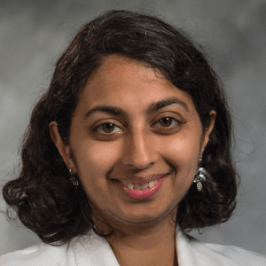
Sneha Mantri, MD, MS, FAAN (Macy Faculty Scholar ’24, Educators ’25), is an Associate Professor of Neurology and Director of Medical Humanities at Duke University School of Medicine. HMI has made an impact on Sneha’s career by providing a supportive, structured community of fellow educators interested in transformational change in academic medicine. Sneha’s areas of professional interest include interprofessional education, health humanities, and equitable care. Sneha can be followed on LinkedIn or contacted via email.